

Is Injustice an Emotion?
- coachinghope4u
- May 25
- 6 min read
🎧 Prefer to listen instead of reading? Click HERE.
The Pain That Wouldn’t Leave
I remember standing in my kitchen one evening, staring out the window while the dishwasher hummed next to me. It should have been an ordinary moment. The kind no one remembers. A half-drunk cup of coffee sat on the counter, cold from being forgotten hours earlier. One of the kids left a backpack near the table. Our dog ran freely in and out of our broken screen door, barking randomly at noises he didn't understand. Ordinary life was happening all around me. I should have been settled and relaxed.
However, inside my body, something entirely different was happening.
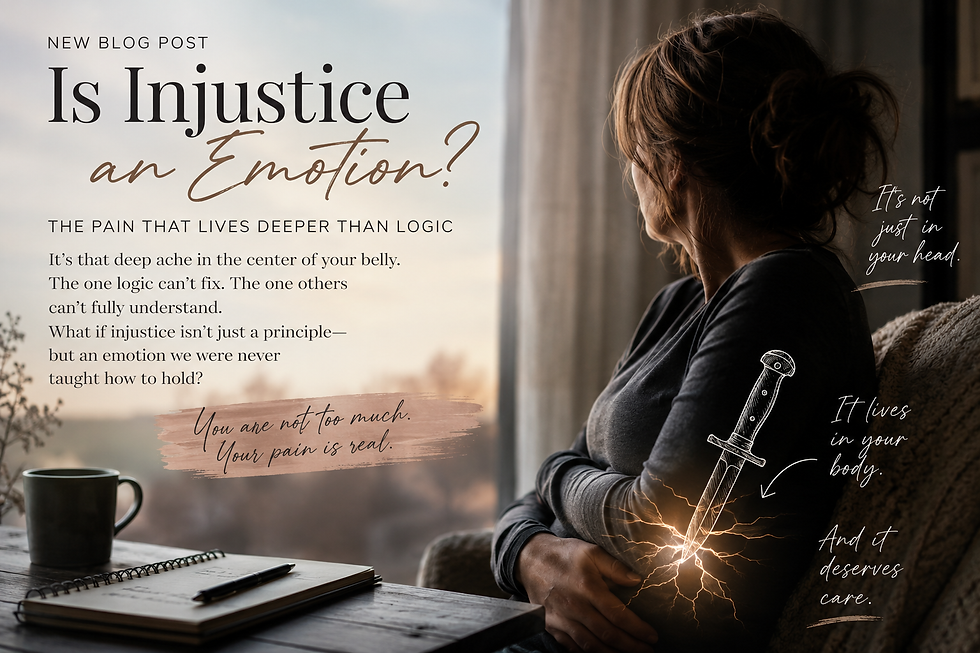
There was a pain in my stomach I couldn’t explain. Not nausea. Not quite anxiety. It was deeper than that, heavier—like someone had slipped a knife into the center of my belly and left it there. Not deep enough to kill me, just enough to make sure I never forgot it was there.
I leaned forward against the counter and pressed my palm against my abdomen as if I could soothe it physically. I remember thinking, "What is this and why does it hurt so much?"
I understood the experiences that had been inserted, unrequested, into my life. I understood what had happened. I could explain the betrayal in coherent sentences. I could outline the timeline, identify the manipulation, name the losses, and even predict the responses people would give me when I spoke about it.
But even after all this time and education, an intense ache remained.
When Understanding Isn’t Enough
That confused me for a long time. Why was the pain still there?
I thought understanding something was supposed to help loosen pain's grip. Isn’t that what we tell people? Learn more. Gain clarity. Process it logically.
Unfortunately, my body didn’t seem particularly interested in logic after living through devastation. I began to realize my body communicated entirely in another language.
Mine spoke in stomach aches. In clenched jaws and grinding teeth. In the early mornings when my racing heart startled me awake, bracing for a danger that wasn't there. Sometimes it felt like heat moving through my chest. Other times it felt cold and hollow, like standing barefoot on my driveway in autumn, watching my children leave for school.
Eventually, I finally found a name for that nagging discomfort.
"Injustice."
Over the years, sitting across from women whose lives have been fractured by betrayal, deceit, abandonment, faith crises, divorce, and relational trauma, I've noticed that nearly all of them arrive at the same unbearable question - the one tethered to the unquenchable ache still living inside them:
What do I do with the injustice of this?
Not just the pain.
THE INJUSTICE. The sheer wrongness of it all.
The fact that someone can dismantle your life and still sit comfortably in church. Still cheer at sports events. Still appear steady while you are trying to remember how to breathe normally inside your own body.
That kind of injustice doesn’t stay neatly contained in the mind. It migrates downward into the nervous system, into the muscles, and into the gut.
The Need to Be Understood
I think that’s why so many women become desperate for others to understand it. Not merely acknowledge it politely, but truly grasp it. They want friends to see it, family to validate it, and faith communities to name it honestly. They want their children to someday comprehend the cost of what happened. Deep down, many carry the hope that if enough people finally understand the magnitude of the injustice, perhaps the pain will begin to loosen its grip.
But most people cannot fully understand an experience they have not survived themselves.
They can observe it.
They can sympathize with it.
But they cannot inhabit it.
Betrayal is like that too. Someone can study trauma, read the books, listen compassionately, and still never fully comprehend the brutality of having reality collapse inside your own home. There are certain wounds that can only be understood by those who have walked through them carrying their own severed pieces.
And maybe injustice belongs in that category.
What If Injustice Is an Emotion?
Lately, I’ve been wondering whether we’ve mislabeled injustice altogether.
What if it is not only a moral principle or philosophical idea?
What if injustice is also an emotion?
Not in the traditional sense that appears on an emotion wheel alongside happiness, sadness, or anger, but as something just as embodied: something lived, something the nervous system carries, the way it carries grief.
If injustice is only a principle, we keep trying to solve it intellectually. We argue facts. We pursue fairness. We demand accountability. We wear ourselves out trying to make reality line up with what should have happened.
But if injustice is also emotional—if it behaves more like grief lodged inside the body—then perhaps it requires a different kind of care.
That would mean the woman weeping on my Zoom call does not need me to explain how people can cause so much devastation. She needs me to recognize the knife still lodged in her gut.
The Body Remembers
Judith Herman wrote extensively about trauma as something that lives beyond narrative. Traumatic experience is not stored in the brain as a neat story with a beginning, middle, and end, but as sensation, fragment, physiological reaction, image, and emotional state—pieces that continue long after the danger has passed. The body remembers what the mind is desperate to organize.
Barb Steffens’ work on betrayal trauma echoes this reality with striking clarity. Betrayal is not devastating simply because of what happened externally. It is devastating because the entire internal system experiences rupture.
Safety collapses.
Attachment fractures.
Meaning disintegrates.
The nervous system stops trusting reality itself.
Injustice hurts physically because the body experiences it physically.
Maybe this is why platitudes feel so painful to wounded people. Statements like “Everything happens for a reason” or “You just need to move forward” can feel like salt pressed directly into an open wound because they bypass the body entirely. They try to resolve intellectually what has not yet been witnessed somatically.
Presence Instead of Answers
Sometimes women come into sessions exhausted from trying to prove that their pain deserves to be recognized. They recount the details again and again, hoping someone will finally say the one sentence that makes the ache disappear.
But there is no such sentence.
There is only presence.
There is only someone willing to sit beside them long enough to name what happened as real, horrifying, and deeply unfair.
No fixing.
No spiritual bypassing.
No rushing toward resilience.
Only a compassionate witness.
I think we support clients differently when we begin to view injustice this way.
Instead of asking, “How do we help her accept reality?” we begin to ask, “Where does she carry it?”
Instead of trying to cognitively reframe every emotion, maybe we become curious about the body itself: the tight throat, the clenched fists, the nausea before court hearings, the trembling after another manipulative email arrives.
What if those responses are not weakness at all, but grief’s answer to injustice?
Learning to Hold It Differently
The older I get, the less interested I am in asking women to prematurely transcend pain. I suspect healing looks less like conquering the injustice of betrayal and more like learning how to hold it without letting it consume the whole self.
That feels more bearable. More human.
The truth is, some injustices are never fully corrected this side of heaven. Some betrayals are never properly acknowledged. Some losses never receive repayment, apology, or public understanding. And still, the body deserves compassion.
And that woman still deserves care.
So maybe the goal is not to stop feeling injustice altogether. Maybe the goal is to learn how not to abandon ourselves while we carry it.
The knife in my stomach still makes itself known from time to time. The sharpness has softened, and the moments are less frequent. But it still returns in certain moments like when an unexpected email lands, when I overhear certain conversations, or when I watch someone else endure profound unfairness.
Now, when it arrives, I do not immediately try to reason it away.
Instead, I place my hand over the pain and meet it with kindness. Rather than asking, “Why am I still feeling this?”
I ask, “What does this pain need from me right now?”

Ready for Support?
If you are navigating betrayal, divorce, or the exhausting work of rebuilding your life, you do not have to do it alone.
Through CoachingHope4U, I offer individual coaching, guided programs, and practical tools to help you move from survival into steady strength.
At Not a Casserole Widow®, we provide education, advocacy, scholarships, and empowerment for women healing from intimate betrayal and divorce.
Explore your next step: www.coachinghope4u.com


I think injustice is not exactly an emotion but a condition or experience that often triggers emotions such as anger, frustration, sadness, or resentment. People react emotionally when they feel they have been treated unfairly. The perception of injustice can vary based on personal values and circumstances. Interestingly, just as opinions differ when discussing social issues, they also differ on everyday topics like the https://texasroadhousemenupro.com/texas-roadhouse-nutrition/ , showing how perspective shapes judgment.
Thanks Kim, this speaks directly to my current experience. The felt undercurrent of injustice has become a constant companion, living deep in my chest, controlling breathing, heart rate and accompanied by racing thoughts. It resonates in me that this is griefs expression of injustice.
Injustice can definitely feel like an emotion because it creates deep frustration, anger, and helplessness in people. Sometimes unfair treatment stays in someone’s mind for years and shapes how they react to situations later in life. Discussions around https://thelegalexperts.org/online-divorce/ also show how emotional people become when they feel unheard or treated unfairly during important decisions. Understanding injustice emotionally may help society build more empathy, fairness, and stronger human connections instead of constant conflict and resentment.